- The Sudbury Weekly Newsletter
- Posts
- Election, right ahead!
Election, right ahead!
Welcome back!
The Annual Town Election is fast approaching, as is Annual Town Meeting. Are we having fun yet?

Speaking of the election—and as a reminder—the deadline for letters/opinion submissions supporting candidates is 11:59PM on Sunday, March 22.
Here’s what we have for you this week:
March 20, 2026 Edition
Let’s get into it!
Sudbury’s Duddy Performance Gym Expands to New Union Avenue Location
NEWS
By Kevin LaHaise
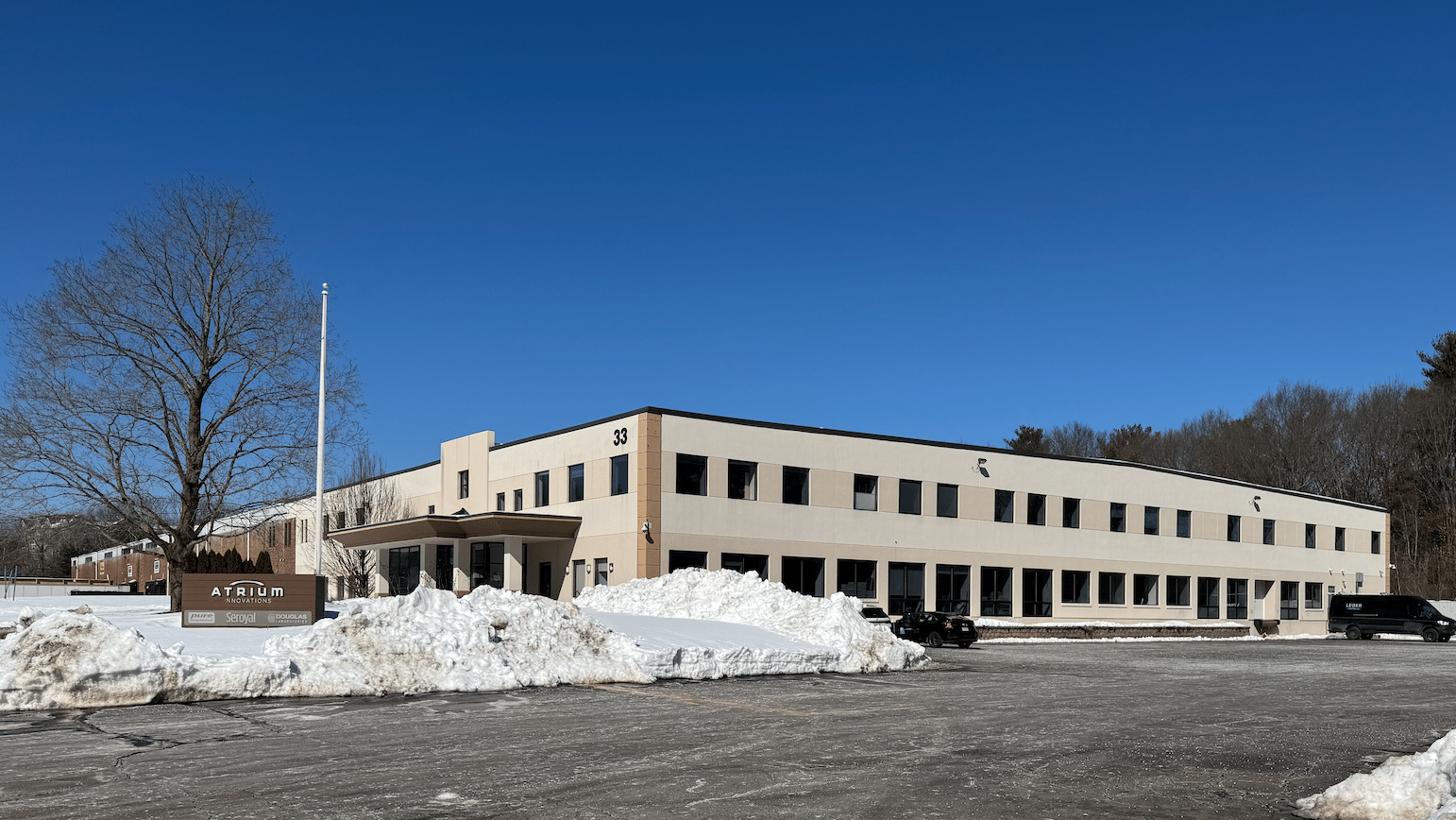
Duddy Performance, a woman-owned small-group and personal training gym, has relocated to a larger facility at 33 Union Avenue to accommodate rapid growth across all age groups. Founded by Liza Duddy in 2021, the business moves to its new home after spending nearly three years at 215 Boston Post Road.
Initially focused on personal training for youth and teen athletes, the gym introduced small group training two years ago, expanding its offerings to adults of all ages and abilities. This new programming quickly boosted membership, prompting an initial expansion at its Boston Post Road location that eventually grew to occupy two levels. Continued demand ultimately necessitated the relocation to an open facility on Union Avenue, where a team of eight certified coaches will continue to serve a growing community of customers.
Memo Debunks “$9M Override” Disinformation

NEWS
By Kevin LaHaise
The Sudbury Public Schools (SPS) School Committee discussed official communications to the community during their March 16 meeting. The committee voiced a desire to address community concerns and misinformation that has been circulating regarding a number of school district matters.
One of the topics that has been subject of widespread misinformation is an alleged “$9M override.” A $9M override has not been proposed. In fact, no override has been proposed.
Sullivan Launches School Committee Write-in Campaign

NEWS
By the League of Women Voters of Sudbury
Jonathan Sullivan notified the Town Clerk Monday of his intention to run as a write-in candidate for the Sudbury School Committee in the March 30 Annual Town Election.
This will be his first run for a seat on the committee.
Two candidates, Julie Durgin and Ellen Lederer-DeFrancesco, previously qualified to be on the ballot for the two open seats on the Sudbury School Committee.
Kouchakdjian Delivers Voc Ed Stunner

NEWS
By Kevin LaHaise
Select Board Chair Lisa Kouchakdjian has been advocating for the Town of Sudbury to get back into a vocational education school district since she was elected to the Select Board in 2022. While the odds always appeared long given the massive demand for access to vocational education in Massachusetts, Kouchakdjian shared an update with the Select Board on March 17 that defied all odds.
Kouchakdjian announced that she was recently contacted by the Superintendent of Minuteman Regional Vocational Technical School District. According to Kouchakdjian, Superintendent Heidi Driscoll reached out and indicated that Minuteman was “really impressed with what we were trying to do at Town Meeting” and suggested the district may be ready to have early conversations about Sudbury re-entering as a member town.
Check Your Mail Ballot; Some Voters Received Lexington Ballots
NEWS
By the League of Women Voters of Sudbury
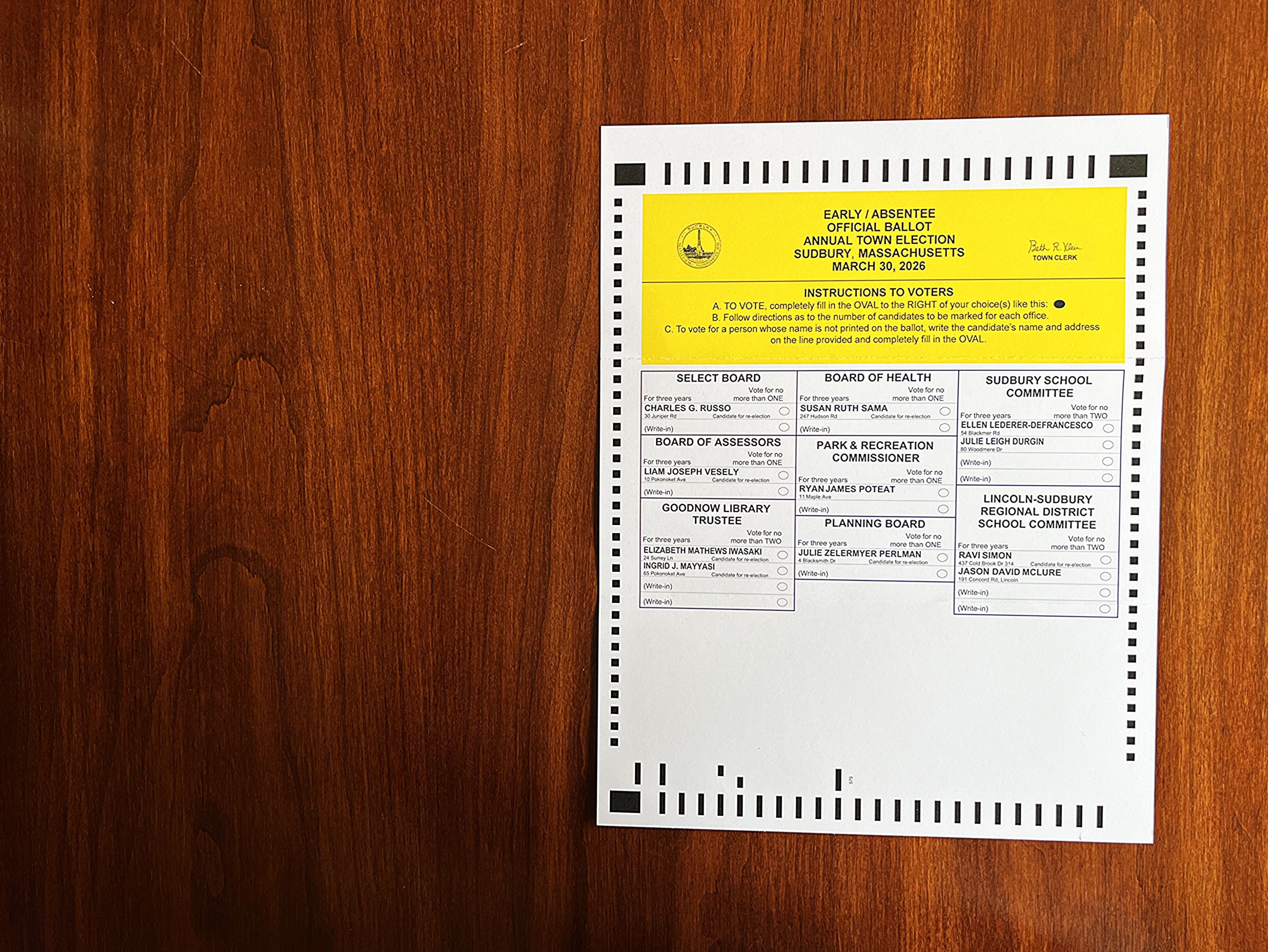
Update: As of Friday morning, March 20, the Town Clerk had still received only seven reports from voters that they had received a Lexington town election ballot instead of a Sudbury ballot.
“It doesn’t seem to be a big problem,” said Beth Klein, Town Clerk.
As of March 20, the clerk’s office has mailed 2,641 town election ballots to voters who requested them, and voters have returned 283 mail ballots.
Sudbury’s Town Clerk is urging voters who received a mail ballot to check immediately to make sure it is a ballot for the Sudbury town election.
The town received an unknown number of ballots for the Lexington town election mixed in with Sudbury ballots, said Beth Klein, Town Clerk. “We think we received only a handful of Lexington ballots from the printer,” but she does not know exactly. As of Wednesday morning, the clerk’s office had heard from “about seven” people who had received the wrong ballot.
The ballots arrived pre-folded from the printer, and the incorrect ballots were inadvertently inserted in the envelopes to Sudbury voters. “We missed it,” she said, noting her office has already processed between 2,700 and 2,800 requests for mail ballots for the town election.
Voters should “check your ballot right away. If it is not correct, call us and we will send you the correct ballot. You don’t need to return the other ballot to us.” The Lexington election was held March 2 and the results of that election are final.
SPS, Nurses’ Association Ratify New Three-Year Contract

NEWS
By Kevin LaHaise
The Sudbury School Committee and the Sudbury School Nurses’ Association have officially ratified a new collective bargaining agreement, marking the end of a collaborative negotiation process in which the nurses sought pay parity with teachers.
The three-year agreement, which was approved by the School Committee on March 17, 2026, is retroactive to July 1, 2025, and will run through June 30, 2028.
Select Board Publication Cites Property Acquisitions, Revenues That Don’t Exist

NEWS
By Kevin LaHaise
An article titled “Camp Sewataro: A Case Study In Public-Private Partnership” ran in the latest Municipal Update publication from the Sudbury Select Board… and it contains some big news, if it were only true.
After sharing a table that presents Camp Sewataro’s private business operating expenses as if they were revenue received by the Town, the article goes on to make comparisons to other Town-owned land and buildings. That includes the following claim:
“Town owned, taxpayer-funded properties with no public access at all include the 43.1 acre (about the same size as Sewataro!) Carding Mill House and grounds at 102 Dutton Road, which has a locked gate with a sign that reads “No trespassing violators will be prosecuted,” and the “South Sudbury Train Station” and “Section Tool House” buildings, both recently purchased via Town Meeting voter action and padlocked shut.” [Emphasis added.]
There’s just one problem: the Town hasn’t purchased the South Sudbury Train Station or the Section Tool House, which are still owned by the Massachusetts Bay Transportation Authority (MBTA).
L-S English Teachers Discuss AI in the Classroom
FEATURES
By Aaron Ortiz
[Editor’s Note: This article is syndicated in collaboration with The Forum — the student newspaper of Lincoln-Sudbury Regional High School. You can also read the article on the Forum’s website here.]
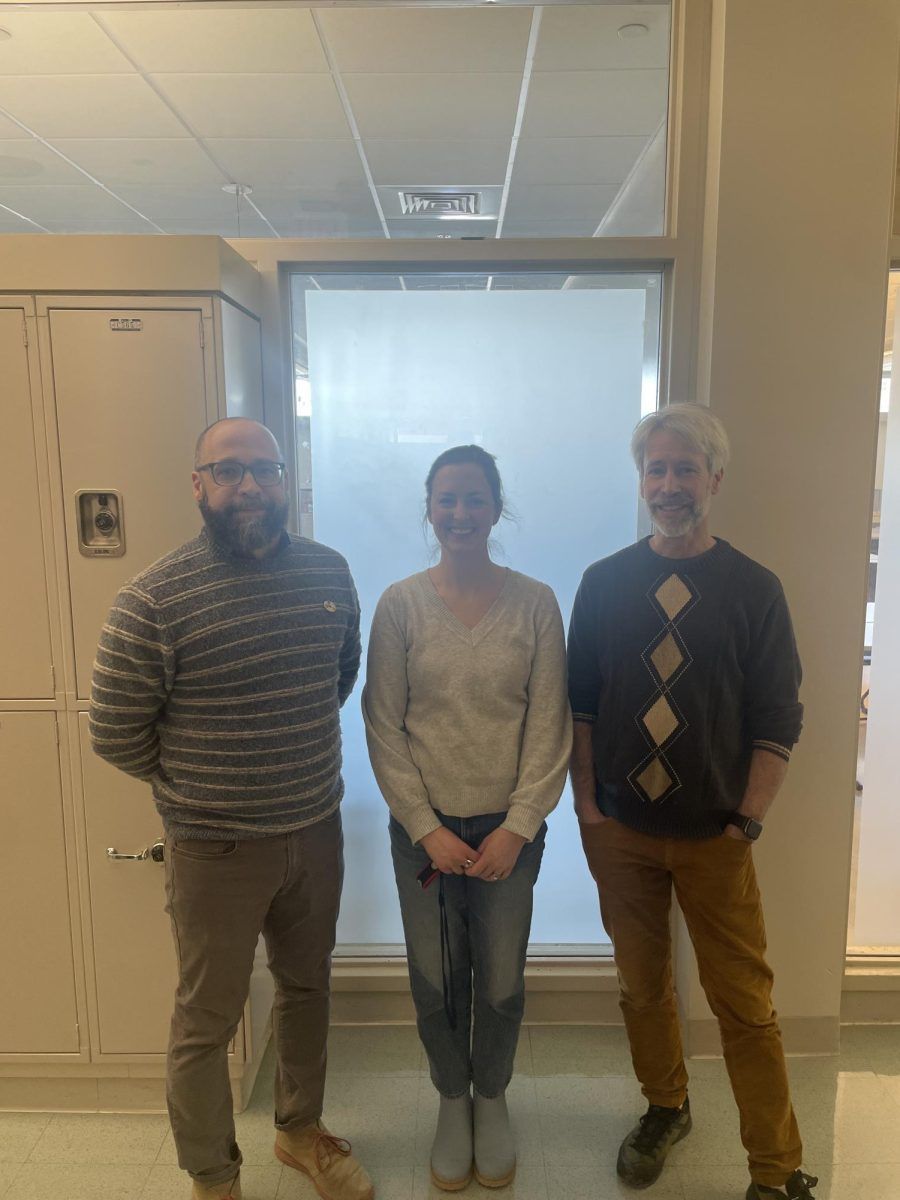
With artificial intelligence becoming increasingly prevalent in our daily lives, questions about its impact cannot be ignored. The controversy around AI’s place in society and academia highlights unresolved issues about its benefits and risks. To understand how others feel at Lincoln-Sudbury, I interviewed English teachers, Mr. Lewis, Ms. Collamore, and Mr. Mason for their perspectives on AI’s influence on both education and the human experience.
Events!



Opinion
Parting Thoughts
With oil and natural gas prices skyrocketing as a result of war… and talk of a “k-shaped” economy, the real-world impact on everyday people is often obfuscated by economist jargon. But there are reports that 1 in 5 American’s can’t afford their electricity bills this winter. And that makes things very, very real.
The combination of war, economic recovery and economic inequality bring the Rural Electrification Act (REA) of 1936 to mind.
Here’s the scene: The United States is in a recovery phase after the first World War and the Great Depression. FDR is trying to juice the economy with the New Deal. But the economy, and technological advancements, disfavored some groups and favored others. There were two Americas. The major cities had virtually all been electrified. But rural farmers didn’t have access to electricity. In fact, less than 10% of rural farms had access.

FDR signed the REA in 1936, stating “Not only are these rural dwellers of America anxious to participate in the advantages of farm electricity, but most of them, as a result of improved farm income, are now in a better position to acquire and make effective use of electrical labor-saving devices.”
It was an effective way to sell a piece of legislation by calling attention to the broader economic benefits for the whole country if this program could help an underserved population. FDR goes on to say:
“The practice has been too frequent in the past for private utility companies to undertake to serve only the more prosperous and more populous rural sections. As a result, families in less favored and in sparsely settled sections were left unserved. I believe that our postwar rural electrification program should bring modern service of electric power to the farm families in the back country.”
The utility companies weren’t evil. They just couldn’t make the unit economics work. Transmission lines cost a lot of money, and the lack of customer density in rural areas meant they would have to charge massive rates if they built the transmission lines — and that was just to recoup their costs. They weren’t price gauging, and often argued their pricing, or lack of interest in rural customers, was just being fair to everyone due to economies of scale.
By the 1950s, over 80% of farms had electricity thanks to the loans and co-op approach in the REA. And the work still continued for decades. In 2016, on the 80th anniversary of the legislation, the USDA wrote “Since 2009, USDA has invested over $34 billion in nearly 1,000 rural electric projects to deliver affordable, reliable electricity to rural areas. Today’s projects strengthen rural electric systems and fund renewable energy and smart grid technologies.”
A policy focused on an underserved group of Americans was ultimately to the benefit of all Americans over many decades. Some credit the REA as a key factor in catapulting the U.S. into the status of an economic superpower in the post-war era.
The brilliance of the loan-based program is that they basically electrified the country… almost for free. It wasn’t a zero-sum game between cities and rural areas, or farmers and power companies. The legislation simply addressed the needs of the underserved.
Fast forward to 1961, and JFK had this to say in his inaugural address:
“If a free society cannot help the many who are poor, it cannot save the few who are rich.”
Onward!